
PEAVEY PV 2000 - 2000 WATT PROFESSIONAL STEREO POWER AMP
Brand : PEAVEY
- SKU:
- PA-RACK-PEAVEY-PV-2000
- Condition:
- Used
- Shipping:
- $79.00 (Fixed Shipping Cost)


PEAVEY PV 2000 - 2000 WATT PROFESSIONAL STEREO POWER AMP
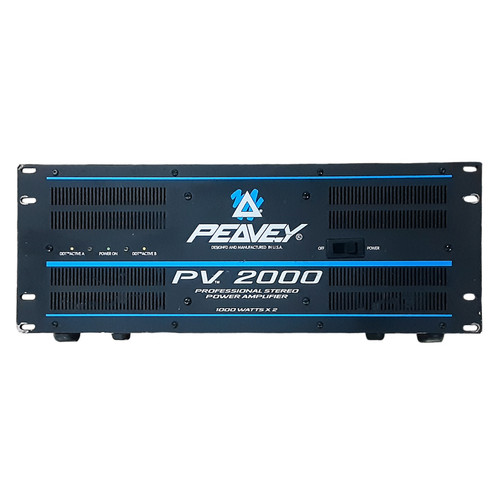
If your standard answer to life’s big questions is “more power!” then the PV 2000 may be for you. The four-rackspace behemoth offers 1000 watts per side into 2 ohms (400 per 8 ohms) and up to 2000 watts in 4-ohm bridged-mono mode. Reported frequency response is as wide as 10 Hz-40 kHz.
The steel chassis seems rugged enough to withstand Armageddon. The amp is cooled by a two-speed fan mounted at the back. The bulk of the PV 2000’s controlsand all connections also appear astern.
Each channel has separate controls for volume, a sub-sonic filter for rolling off low end below 40 Hz, a DDT compression enable switch and a crossover switch, which splits out high frequencies, allowing a number of cool options: you could, for example, power a subwoofer with one channel and a standard monitor with the other. DDT is Peavey’s version of automatic speaker protection, applying compression automatically whenever the amp is clipping. Other controls include a stereo/mono switch and a circuit breaker, to protect the amp from meltdown. Each channel has a pair of parallel ¼-inch TRS balanced/unbalanced inputs; speakers connect to either ¼-inch jacks or binding posts. The front panel houses the power switch and indicator lights that signal DDT activity.
The amplifier features include a 2-way crossover and sub-sonic filter for each channel. The crossover frequency is fixed at 150 Hz, which allows subwoofers to be driven to extremely high sound pressure levels. The sub-sonic filter is fixed at 40 Hz to prevent unwanted low end rumble. This amplifier uses proven technology gained from years of amplifier design, taking advantage of the rugged steel can TO-3 output devices for reliability. Unlike typical home stereo units, the PV 2000 employs massive power transformers, very effective two-speed fan cooling, and offers impressive specifications and features not found on any other competitive unit in this price range. This amplifier was designed to drive 2 ohm loads per channel, thus delivering awesome performance levels at 4 ohm Bridge mode. The PV 2000 offers rugged rack-mountable construction and more than adequate patching capability. The front panel contains a rocker mains switch, an LED power indicator, and dual LED DDT’” activation indicators. The back panel of each amplifier has an input level control, dual l/4” phone jack inputs, 5-way binding post outputs, and dual l/4” phone jack outputs for each channel. There is a l/4” phone jack output for each channel’s high-frequency crossover. The resetable mains breaker is also located on the back. Additionally, the back contains switches for Stereo/Bridge select and DDT defeat, sub- sonic filter and active crossover switches.
FRONT PANEL FEATURES
DDT ACTIVE LEDS
Illuminates when DDT compression is taking place in the channel. With the Enable/Defeat switch on the back panel in the Defeat position, this LED indicates when channel clipping is occurring.
POWER LED
Illuminates when AC mains power is being supplied to the amp and both channels are operational. If either channel were to experience fault conditions, exceed the safe operating temperature limits, or have the associated circuit breaker trip, then the power LED will go out, indicating such conditions exist.
CIRCUIT BREAKERS
There are two circuit breakers (one for each channel) on the PV’” 2000 have only one. These breakers are provided to limit the current to the associated power transformer and protect it from overheating and possible destruction due to fault conditions in the amplifier. The trip current values have been
carefully chosen to allow continuous power output performance while still protecting the power trans- former. Normally, these breakers should not trip unless there is a fault in the amplifier circuitry that draws excessive mains current. However, abnormal conditions such as a short circuit on either or both channels, or continuous operation at overload or clipping (especially into 2 ohm loads) will cause the breaker to trip. If this occurs, turn the power switch off, then simply reset the breaker and correct the cause of the overload.
BACK PANEL FEATURES
POWER SWITCH
A heavy-duty, rocker-type switch. Selecting the “0” position turns off the power amplifier.
DDT SWITCH
This switch is used to either Enable or Defeat the DDT compressor. Normally the DDT function should be enabled to minimize the possibility of either or both channels going into clipping or overload. With DDT defeated, a severe overload could cause the mains circuit breakers to trip as a matter of course. (The Peavey DDT compression system will be covered in greater detail later in this manual.)
MODE SWITCH
This switch is used to select either Stereo or Bridge mode of operation. Care should be exercised whenever the Bridge mode is selected. Accidental selection of this mode could damage loudspeakers, particularly in biamped systems. (The Bridge mode will be covered in greater detail later in this manual.)
INPUT GAIN
These controls are used to adjust the input gain of each channel. Thus, they determine how “loud” each channel of the power amplifier will “play” for a given input signal level. Maximum input gain (minimum sensitivity rating) is achieved at the full clockwise setting, and this setting yields maximum mixer/system headroom. A setting of less than full clockwise will yield lower system noise at the expense of mixer/ system headroom.
HIGH-Z INPUT JACKS
Two parallel i/4” stereo input jacks are provided for each channel. This allows one to be used as a conventional input and, simultaneously, the other to be used as a “line out” (Y-cord) to connect to another input jack on this amplifier or other amps or equipment. These l/4” jacks are not chassis grounded and will provide a unique ground loop elimination circuitry associated with each input. This feature will normally allow “hum-free” operation when relatively short i/4” cable patches are made between the jacks on this amp and other jacks on various other equipment that share the same rack with this amp. The inputs are true electronically balanced to further eliminate any hum. A l/4” stereo jack can be used at the input with the tip being the positive phase, the ring being the negative phase and the sleeve connected to ground. A mono l/4” jack can also be used creating an unbalanced input.
HIGH OUT CROSSOVER JACKS
These output jacks are provided for crossover capability. With the crossover switch depressed, the low- frequency signal is automatically routed to Channel A. The high-frequency signal has to be patched to the input of Channel 6 from this jack. If both channels are being used for the lows, (either Bridge mode or Stereo) then the HI OUT jacks can be connected to another amplifier to provide the highs in a 2-way system.
SPEAKER OUTPUTS
A Two l/4” jacks and 5way binding post speaker output terminals are provided for each channel. Again, for each channel, these outputs are in parallel; hence, the speaker connection cables can be terminated with l/4” phone plugs, banana plugs, or stripped wires for use in the binding post terminals. For sustained high power applications, the use of the binding post terminals is recommended. However, care must be exercised to assure correct speaker phasing.
CROSSOVER SWITCH
This switch is used to select the crossover capability of this amplifier. With this button depressed, the low frequecies are automatically sent to the corresponding channel. The high frequencies are sent to the HI OUT jack, which can be connected to either the other channel’s input or another amplifier. The crossover frequency is fixed at 150 Hz.
SUB-SONIC FILTER
Depressing this switch to the ‘<in” position provides a 40 Hz high-pass filter for the corresponding channel. This will cut ultra-low frequencies, protecting speakers from the possibility of over-excursion. The low-frequency roll-off is 18 dB per octave.